Article by:
Retreat Finder

Not every retreat begins with stillness. Some start with a blank page and a color you didn’t expect to choose.
Process painting is not about making art—it’s about meeting yourself. In a world driven by outcomes and achievements, this practice invites something rare: a return to presence, intuition, and creative freedom without a map.
Stewart Cubley, founder of The Painting Experience, has guided thousands through this transformational work. His invitation is simple yet radical: “The first step is to be willing not to know.”
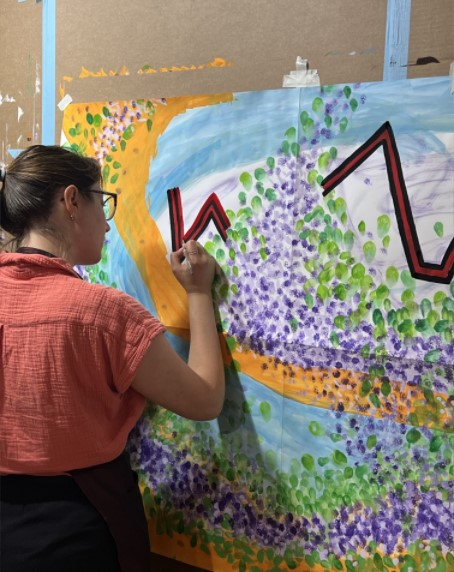
Imagine standing before a canvas with no plan, correct answer, or model to follow: just a brush, a choice of color, and the quiet encouragement to begin.
In this space, you’re not trying to make something beautiful. You’re not trying to make anything at all. You’re listening. Responding. Noticing the urge to reach for red. The impulse to paint a shape that doesn’t make sense. The inner dialogue that tells you not to.
This is where the real work begins, not with technique but with trust. Trust in your imagination, trust in the moment, and trust that what arises is worthy, even when unfamiliar, messy, or vulnerable.

To explore the unknown, you need a container that holds you with care. Retreats offer a sacred space where urgency and expectation fall away—a space where time expands and attention softens.
In this space, process painting becomes more than a creative outlet. It becomes a mirror, a way to see where you resist, where you judge, where you protect yourself—and a way to stay anyway. With every brushstroke, you practice being in relationship with the unknown—with your impulses, your fear, your longing.
And with others on the same journey, something collective unfolds: shared courage, stillness, and insight.
Stewart’s approach isn’t about giving instructions. It’s about inviting curiosity. The studio becomes a field of permission, not performance. There are quiet agreements—respect the space, respect each other, respect your process—but no rules about what the painting must become.
You are asked to be honest, not impressive. To be responsive, not reactive. To let go when it’s time. And to stay when you’d rather start over.
Process painting reaches far beyond the studio walls. It teaches what few traditional systems do:
These lessons travel home with you, into your parenting, relationships, grief, and growth—into the parts of life that don’t come with a manual or a perfect answer.
For many, this work becomes a turning point—a threshold. Whether navigating loss, transition, or simply yearning for deeper connection, process painting offers a way that doesn’t require explanation, only your willingness to show up.
Because when you paint from the inside out, the goal is not art, it’s authenticity. Not mastery, but meaning. And when you’re willing not to know, you open the door to a more profound knowing.

 Log in with Google